


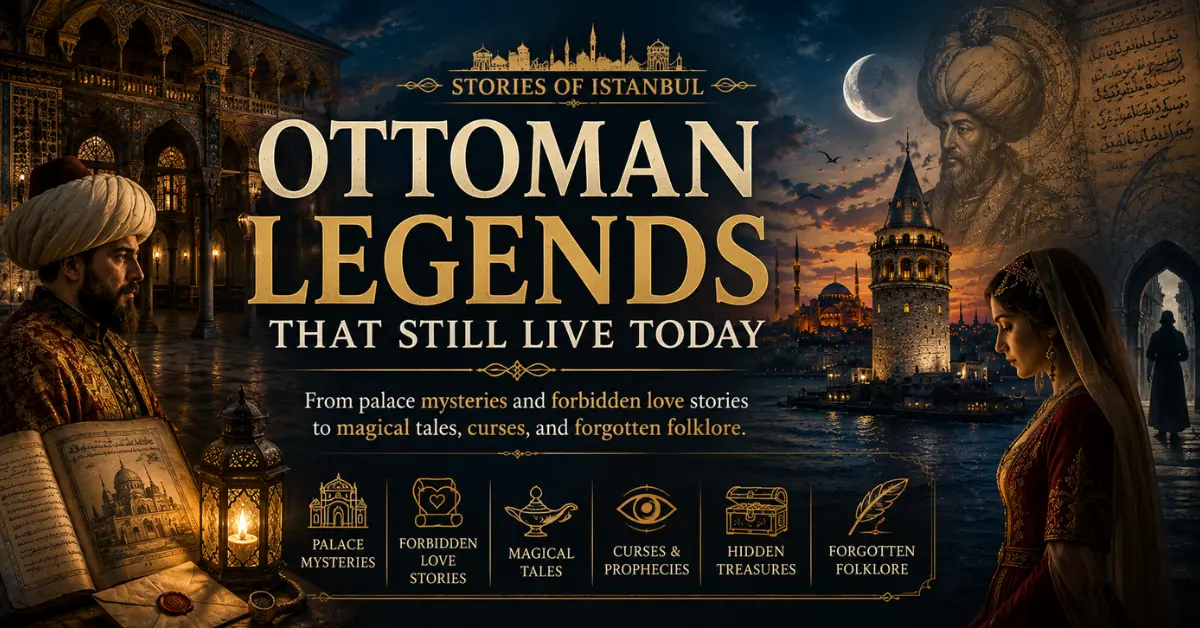
Ottoman Legends That Still Live Today
10 Fascinating Ottoman Stories, Myths, and Legends from Istanbul
For more than six centuries, the Ottoman Empire shaped the history, architecture, culture, and identity of Istanbul.
Sultans ruled from magnificent palaces. Grand mosques transformed the skyline. Merchants filled the bazaars, ships crossed the Bosphorus, and stories travelled from one neighborhood to another.
But the Ottoman legacy is not found only in historical documents and monuments.
It also survives in stories.
Some were told inside imperial palaces. Others were passed down through families, coffeehouses, markets, and neighborhoods. Some describe mysterious events, while others tell stories of love, tragedy, supernatural encounters, and extraordinary people.
Over time, fact and folklore became intertwined.
In this chapter of Stories of Istanbul, we explore some of the most fascinating Ottoman legends that still live today.
A note about the stories: These tales belong to Istanbul’s historical folklore. Some are connected to real people and places, while others cannot be independently verified. They should be understood as legends rather than established historical facts.
1. The Legend of Hezarfen Ahmed Çelebi
One of the most famous Ottoman stories connected to Istanbul is the extraordinary tale of Hezarfen Ahmed Çelebi.
According to the famous Ottoman traveler Evliya Çelebi, Ahmed Çelebi designed artificial wings and launched himself from Galata Tower.
The story says that he flew across the Bosphorus and landed on the Asian side of Istanbul.
If the account is taken literally, it would have been an astonishing achievement for the 17th century.
According to Evliya Çelebi’s account, Sultan Murad IV was impressed but ultimately considered the feat dangerous and sent Ahmed Çelebi into exile.
Whether the flight happened exactly as described remains debated.
But the legend has become inseparable from the history of Galata Tower.
Today, the story represents one of Istanbul’s most imaginative connections between science, ambition, and folklore.
2. The Secret Stories of Topkapı Palace
Topkapı Palace was the heart of Ottoman imperial power for centuries.
Behind its magnificent courtyards and ceremonial buildings were stories of political intrigue, royal rivalries, succession struggles, secret alliances, and dramatic decisions.
The palace has inspired countless legends about hidden rooms, secret passages, mysterious objects, and conversations that supposedly changed the course of the empire.
Some stories have historical foundations.
Others developed through popular imagination.
The palace’s enormous scale makes it easy to understand why legends developed around it.
Thousands of people lived and worked within its walls, while access to certain areas was strictly controlled.
A place where emperors, princes, officials, servants, and foreign ambassadors interacted naturally became a place of secrets.
3. The Legend of the Sultan’s Dream
Ottoman history contains numerous stories involving dreams and prophecies.
One of the most famous traditions concerns Osman I, regarded as the founder of the Ottoman dynasty.
According to the traditional story, Osman had a dream in which a tree emerged from his body and grew into an enormous tree whose branches covered vast lands.
The dream was interpreted as a prophecy of the future expansion of the Ottoman state.
Whether the dream happened exactly as described is impossible to establish.
But the story became enormously important in Ottoman historical tradition because it provided a symbolic explanation for the rise of the dynasty.
The tree represented growth, power, and imperial expansion.
4. The Legend of the Süleymaniye Mosque
The magnificent Süleymaniye Mosque was commissioned by Sultan Süleyman the Magnificent and designed by the great Ottoman architect Mimar Sinan.
Its construction generated stories that survived long after the mosque was completed.
One popular tradition concerns Sinan’s architectural genius and his ability to solve seemingly impossible engineering problems.
Stories about the mosque’s construction often emphasize the precision of its dome, foundations, acoustics, and ventilation.
While many popular versions have become embellished over time, they reflect something historically significant:
The Ottoman public viewed monumental architecture as evidence of extraordinary technical and artistic achievement.
The mosque therefore became surrounded by stories celebrating Sinan’s genius.
5. The Mystery of Mimar Sinan’s Engineering
Mimar Sinan is perhaps the most legendary architect of the Ottoman period.
He designed hundreds of structures, including mosques, bridges, schools, baths, and other public buildings.
Because of the sophistication of his architecture, numerous stories developed around his methods.
Some legends portray Sinan as possessing almost supernatural architectural intuition.
Others tell of secret techniques or hidden calculations that allowed him to create enormous domes and perfectly balanced structures.
The historical reality is impressive enough.
Sinan was an exceptional engineer who worked within a sophisticated architectural tradition and transformed Ottoman architecture.
The legends simply added another layer of mystery to his reputation.
6. The Curse of the Ottoman Princes
The Ottoman succession system produced some of the darkest stories in imperial history.
The struggle for the throne could become extremely dangerous, particularly for princes competing for succession.
Historical practices surrounding royal succession included severe measures intended to prevent civil war.
These events created stories of betrayal, secret imprisonment, family tragedy, and palace intrigue.
Over generations, the historical events became increasingly dramatic in popular storytelling.
The result is an enduring image of the Ottoman palace as a place where power could come at an enormous personal cost.
Unlike supernatural legends, many of these stories are rooted in documented Ottoman history.
7. The Legend of the Maiden’s Tower
Although the Maiden’s Tower predates the Ottoman Empire, its legends continued to evolve during the Ottoman period.
The most famous story tells of a ruler whose daughter was destined to die from a snakebite.
To protect her, he supposedly placed her inside a tower surrounded by water.
But fate could not be avoided.
A snake hidden inside a basket of fruit reached the tower and killed the princess.
The story is not accepted as established history.
It is a legend.
Yet it became one of the most enduring stories associated with Istanbul.
The Maiden’s Tower therefore demonstrates how older legends could survive and become part of Ottoman and later Istanbul folklore.
8. The Mysterious World of Ottoman Coffeehouses
Coffeehouses became important social spaces in Ottoman Istanbul.
People gathered there to drink coffee, discuss politics, listen to stories, play games, and exchange news.
They were also places where legends could spread rapidly.
A strange event in one neighborhood could become a supernatural story in another.
A mysterious traveler could become a legendary character.
A real political event could be transformed into a dramatic tale.
In this way, Ottoman coffeehouses helped preserve the oral storytelling culture of Istanbul.
Many stories that survived into modern times were shaped by generations of retelling.
9. Ottoman Djinn and Supernatural Stories
Ottoman-era folklore contains numerous stories involving djinn, spirits, mysterious beings, and supernatural encounters.
These stories were often associated with abandoned buildings, old cemeteries, isolated roads, fountains, forests, and other places considered mysterious.
Stories about supernatural encounters were part of the broader cultural imagination of the period.
They were not necessarily viewed simply as entertainment.
For many people, folklore was closely connected to beliefs about the unseen world, dreams, omens, and unexplained events.
Today, these stories remain part of Istanbul’s cultural folklore.
10. The Legend of Hidden Treasures
Few things create a legend faster than the idea of buried treasure.
Stories of hidden Ottoman treasures have circulated for generations.
Some tales claim that wealthy families, officials, or soldiers hid valuable objects during periods of war and political uncertainty.
Other stories speak of secret chambers beneath old mansions or forgotten underground spaces containing gold and precious objects.
Most such stories lack reliable evidence.
Nevertheless, Istanbul’s complicated history makes the idea particularly attractive.
The city has experienced wars, occupations, political upheaval, and enormous demographic changes.
It is therefore easy to imagine how stories about forgotten treasures could survive for generations.
Why Did Ottoman Legends Become So Powerful?
The Ottoman Empire lasted for centuries.
That gave generations of storytellers an enormous historical landscape from which to create legends.
The empire contained:
- Sultans and princes
- Palaces and harems
- Soldiers and diplomats
- Architects and artists
- Merchants and travelers
- Religious scholars
- Mystics and storytellers
- Foreign visitors
- Ordinary citizens
Every group had its own stories.
Some stories were written down.
Others were told verbally.
Some disappeared.
Others survived because they were particularly dramatic.
And the most memorable stories often became legends.
History vs. Legend
One of the most important things to remember when exploring Ottoman stories is that not every fascinating story is historically proven.
For example, the existence of Ottoman sultans, palaces, mosques, architects, wars, and political events can be documented through historical sources.
A story about a supernatural encounter or an extraordinary prophecy may belong to folklore instead.
That does not make the story meaningless.
Legends are valuable because they reveal how people understood their world and how historical memories were transmitted between generations.
Why Do Ottoman Legends Still Matter Today?
Ottoman legends remain part of Istanbul’s cultural identity.
You can encounter them in museums, historical neighborhoods, books, television productions, guided tours, local conversations, and traditional storytelling.
Some visitors come to Istanbul looking for monuments.
Others come looking for stories.
And often, the story makes the monument much more memorable.
Galata Tower becomes more than a tower when you know the story of Hezarfen Ahmed Çelebi.
Maiden’s Tower becomes more than a small building on the Bosphorus when you hear the tragic princess legend.
Topkapı Palace becomes more fascinating when you understand the political world that existed behind its walls.
Stories give history a human dimension.
Frequently Asked Questions
What are the most famous Ottoman legends?
Some of the best-known stories include the legend of Hezarfen Ahmed Çelebi, Osman I’s prophetic dream, stories surrounding Mimar Sinan, the legends of Maiden’s Tower, palace mysteries, hidden treasures, and Ottoman supernatural folklore.
Are Ottoman legends based on real events?
Some are connected to real historical people and events, while others are purely traditional folklore. Each story should therefore be examined separately.
What is the most famous Ottoman legend in Istanbul?
The story of Hezarfen Ahmed Çelebi flying from Galata Tower across the Bosphorus is among the most famous Ottoman-era legends associated with Istanbul.
Did Ottoman sultans believe in legends?
Ottoman society was deeply influenced by religious traditions, folklore, dreams, omens, historical narratives, and popular storytelling. Individual beliefs varied, so broad claims about every sultan should be avoided.
Where can I discover Ottoman legends in Istanbul?
Historic areas such as Sultanahmet, Topkapı, Galata, Beyoğlu, Üsküdar, and the Bosphorus are particularly rich in stories connected with the Ottoman period.
The Legends That Refuse to Disappear
Empires eventually disappear.
Palaces change their function.
Generations come and go.
But stories can survive.
That is why Ottoman legends remain part of Istanbul today.
Some are supported by historical evidence.
Some are partly historical.
Others belong entirely to folklore.
Yet each one tells us something about the people who created, remembered, and repeated it.
Perhaps that is the greatest power of a legend.
It does not need to be completely true to survive.
It only needs to be memorable.
And Istanbul has never been short of memorable stories.
This is Stories of Istanbul.