

The Most Haunted Places in Istanbul
Ghost Stories, Dark Legends, and Mysterious Places Across the City
Istanbul is a city built on layers of history.
Beneath its streets lie ancient cisterns. Along its walls stand medieval fortresses. Ottoman mansions overlook the Bosphorus, while centuries-old buildings continue to tell stories about emperors, sultans, prisoners, soldiers, and ordinary people who once lived in the city.
With so much history, it is hardly surprising that Istanbul has developed its own collection of ghost stories and supernatural legends.
Some places are associated with tragic historical events. Others became “haunted” in local folklore because they stood empty for years or had a mysterious appearance. And some stories have been passed from generation to generation without any reliable evidence that the supernatural events actually occurred.
So, are these places really haunted?
There is no scientific evidence proving that they are.
But their stories are fascinating.
Welcome to another chapter of Stories of Istanbul, where history, folklore, mystery, and legend meet.
1. Yedikule Fortress and Its Dark History
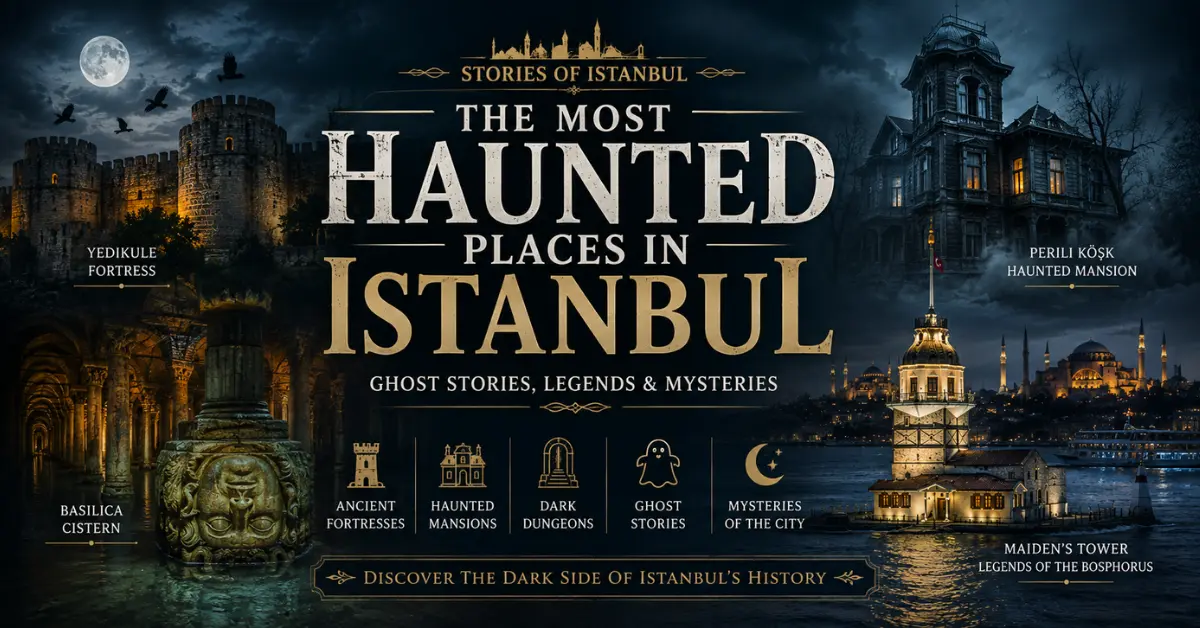
Few places in Istanbul have a darker reputation than Yedikule Fortress.
Located near the historic city walls, Yedikule combines ancient Roman structures with a fortress built during the Ottoman period. The complex became associated with imprisonment and executions, giving it a particularly grim place in Istanbul’s collective memory.
The fortress was used at different times for diplomatic prisoners, political prisoners, and other detainees. Historical accounts and local stories surrounding the site have contributed to its reputation as one of Istanbul’s most unsettling historical locations.
The atmosphere is especially powerful inside the old towers.
Dark stone corridors, massive walls, and the knowledge of what happened there make it easy to understand why ghost stories developed around the fortress.
Istanbul’s municipality describes Yedikule’s dungeons, the so-called Bloody Well, and the execution chamber associated with Sultan Osman II as parts of the site’s darker historical legacy.
Is Yedikule really haunted?
There is no reliable evidence proving that ghosts inhabit the fortress.
Its reputation comes primarily from its history, legends, and the emotional impact of a place that witnessed imprisonment and death.
2. Perili Köşk – The Haunted Mansion
If Istanbul has a building that looks as though it belongs in a gothic ghost story, it is Perili Köşk.
Its official name is the Yusuf Ziya Pasha Mansion, and it stands on the European shore of the Bosphorus near Rumelihisarı.
The mansion’s unusual red-brick architecture and castle-like towers immediately attract attention.
But why is it called Perili Köşk, meaning “Haunted Mansion”?
The answer is surprisingly practical.
Construction began in the 1910s, but work stopped during World War I when construction workers were called to military service. Parts of the building remained unfinished and empty for decades.
According to Borusan Contemporary, the unfinished upper floors were left vacant, and local people began referring to the building as “Perili Köşk.”
Over time, folklore added more dramatic explanations.
Stories appeared about mysterious figures, strange sounds, and spirits supposedly associated with the mansion.
But the historical explanation for the nickname is much less supernatural—and perhaps even more interesting.
Is Perili Köşk actually haunted?
There is no verified evidence that the mansion is haunted.
Its reputation is primarily part of Istanbul’s urban folklore.
Today, the historic building is home to Borusan Contemporary and is part of Istanbul’s cultural scene rather than an abandoned haunted house.
3. Rumeli Fortress
Standing beside the Bosphorus, Rumeli Fortress is one of Istanbul’s most impressive medieval fortifications.
Built in 1452 by Sultan Mehmed II before the Ottoman conquest of Constantinople, the fortress was designed to control the Bosphorus at one of its narrowest points.
But behind its spectacular views and massive towers lies a darker atmosphere.
The fortress was built for war.
Its walls witnessed the final years of the Byzantine Empire, military preparations, and the dramatic events surrounding the conquest of Constantinople.
Over the centuries, stories about soldiers, prisoners, deaths, and unexplained sounds contributed to its mysterious reputation.
Walking through the fortress at quieter times, particularly when the wind moves through the empty stone towers, it is easy to understand why the location inspires supernatural stories.
Is Rumeli Fortress haunted?
There is no established evidence of paranormal activity.
Its “haunted” reputation is better understood as folklore connected to its military history and dramatic architecture.
4. The Old City Walls of Istanbul
The Walls of Constantinople are among the greatest surviving examples of ancient defensive architecture in the world.
Stretching across the historic peninsula, they protected Constantinople for centuries.
But walls built for war inevitably carry stories of violence, sieges, imprisonment, and death.
Some sections are quiet and isolated, especially after sunset, which has encouraged local legends about mysterious figures and unexplained sounds.
The combination of ancient stones, abandoned-looking sections, vegetation, and centuries of history creates an atmosphere unlike anywhere else in Istanbul.
What makes the city walls mysterious?
It is not necessarily the supernatural.
It is the feeling of standing beside a structure that has witnessed the collapse of an empire.
5. The Dark Stories of Yedikule’s “Bloody Well”
Within Yedikule Fortress is one particularly disturbing feature known in Turkish as Kanlı Kuyu, or the “Bloody Well.”
Stories surrounding the well have helped create some of the darkest legends associated with Yedikule.
Historical accounts and popular storytelling have blended over time, making it difficult to separate every detail of the stories from later folklore.
But the reputation remains.
For visitors interested in Istanbul’s darker history, the Bloody Well represents the difference between the romantic Istanbul of palaces and mosques and the much harsher reality of imperial life.
6. The Maiden’s Tower
At first glance, Maiden’s Tower looks romantic rather than frightening.
Standing alone in the Bosphorus, it is one of Istanbul’s most beautiful landmarks.
But some of its most famous stories are tragic.
One legend tells of a princess whose father was warned that she would die from a snakebite. He supposedly placed her in a tower surrounded by water to protect her from the prophecy.
On her eighteenth birthday, however, a snake hidden inside a basket of fruit reached the tower and killed her.
The story is a legend rather than documented history, but it has become one of the most famous tales associated with Istanbul.
Another tragic legend connects the tower with Hero and Leander.
The stories are romantic, mysterious, and tragic—but they are not evidence that the tower is haunted.
7. Topkapı Palace and Stories of the Imperial Past
Topkapı Palace was the center of Ottoman imperial power for centuries.
Behind its beautiful courtyards and magnificent collections lies a much more complicated history.
The palace witnessed political intrigue, executions, royal rivalries, succession struggles, and dramatic changes in the Ottoman dynasty.
These stories have inspired numerous legends about mysterious corridors, secret rooms, and supernatural encounters.
However, many stories circulating online should be treated carefully.
Historical palace architecture is real.
Ghost stories are folklore.
The distinction makes the subject even more fascinating.
8. The Princes’ Islands
The Princes’ Islands are famous for their peaceful atmosphere, historic mansions, pine forests, and beautiful sea views.
But the islands also have a darker historical side.
For centuries, some islands were used as places of exile.
Byzantine emperors sent political opponents and members of rival dynasties to the islands.
Monasteries and isolated locations added to their reputation as places of solitude.
Stories about exiles, monks, abandoned buildings, and mysterious nighttime sounds eventually became part of the islands’ folklore.
The peaceful scenery therefore hides a surprisingly dramatic history.
9. Old Ottoman Mansions Along the Bosphorus
The Bosphorus is famous for its magnificent yalıs, or waterfront mansions.
Some have centuries of family history behind them.
Others are connected to stories of wealthy Ottoman officials, political intrigue, romance, tragedy, and family disputes.
The mysterious appearance of certain old mansions—especially those with dark wooden façades and empty-looking upper floors—has inspired ghost stories.
But these stories should be regarded as folklore rather than established supernatural events.
The real history of the families who lived inside them is often fascinating enough.
10. The Underground World of Istanbul
Some of Istanbul’s most mysterious places are beneath the streets.
The city’s ancient cisterns, underground chambers, water channels, and archaeological structures have inspired countless stories.
The Basilica Cistern is the most famous example.
Its enormous columns, dark water, and low lighting create an atmosphere that feels almost supernatural.
But there is a perfectly historical explanation for its mysterious appearance.
The cistern was an enormous Byzantine water reservoir.
Its purpose was practical.
Its atmosphere is simply extraordinary.
Why Does Istanbul Have So Many Ghost Stories?
There is a simple explanation.
Istanbul is extremely old.
The city has existed for thousands of years and has served as the center of different civilizations.
Greeks.
Romans.
Byzantines.
Ottomans.
Modern Turkey.
Each period left behind buildings, cemeteries, fortifications, palaces, churches, mosques, and stories.
When history accumulates on this scale, legends naturally develop.
A ruined building becomes a haunted house.
An old fortress becomes a place of restless spirits.
A tragic historical event becomes a ghost story.
Over generations, the boundary between history and folklore becomes increasingly difficult to see.
Are the Haunted Places in Istanbul Really Haunted?
There is currently no reliable scientific evidence proving that the historic locations described in this article are inhabited by ghosts or supernatural entities.
Their haunted reputations come from:
- Local folklore
- Historical tragedies
- Urban legends
- Architectural atmosphere
- Stories passed through generations
- Popular culture
- Personal experiences reported by visitors
That does not make the stories uninteresting.
In fact, it makes them part of Istanbul’s cultural heritage.
Frequently Asked Questions
What is the most haunted place in Istanbul?
Yedikule Fortress and its former dungeons are among the places most strongly associated with dark stories and legends because of their long history of imprisonment and executions.
Is Perili Köşk really haunted?
There is no verified evidence that Perili Köşk is haunted. Its famous nickname, meaning “Haunted Mansion,” is strongly associated with the building’s unfinished and empty upper floors during the early 20th century.
Are there ghost stories about the Maiden’s Tower?
Yes. Maiden’s Tower is associated with several tragic legends, particularly the story of the princess and the snake and the tale of Hero and Leander. These are legends rather than verified supernatural events.
Why is Yedikule Fortress considered scary?
Its massive medieval walls, dark towers, former prison spaces, and association with executions and political prisoners have contributed to its unsettling reputation.
Does Istanbul have haunted houses?
Istanbul has several buildings associated with ghost stories and urban legends. Perili Köşk is the best-known example, although its “haunted” reputation is primarily folkloric.
What are the most mysterious places in Istanbul?
Some of the city’s most atmospheric locations include Yedikule Fortress, Perili Köşk, Rumeli Fortress, Maiden’s Tower, the historic city walls, the Princes’ Islands, and the underground cisterns.
The Ghosts of Istanbul May Be Its Stories
Perhaps Istanbul’s most haunting feature is not the possibility of ghosts.
It is memory.
The stones of Yedikule remember prisoners.
The walls remember armies.
The Bosphorus remembers ships.
The old mansions remember families.
The Maiden’s Tower remembers legends.
And the ancient cisterns preserve the engineering achievements of a civilization that disappeared centuries ago.
Whether you believe in ghosts or not, these stories reveal something important about Istanbul.
The city does not simply preserve its history in museums.
It carries its history through stories.
Some are documented.
Some are legends.
Some remain mysteries.
And that is exactly what makes Istanbul such a fascinating city to explore.
This is Stories of Istanbul.