

The Curse of the Serpent Column
The Ancient Monument, the Missing Serpent Heads, and the Legend Behind Istanbul’s Mysterious Column
In the heart of Istanbul’s historic Sultanahmet district stands a monument that is easy to overlook.
It is not enormous.
It does not have a magnificent dome.
It does not dominate the skyline.
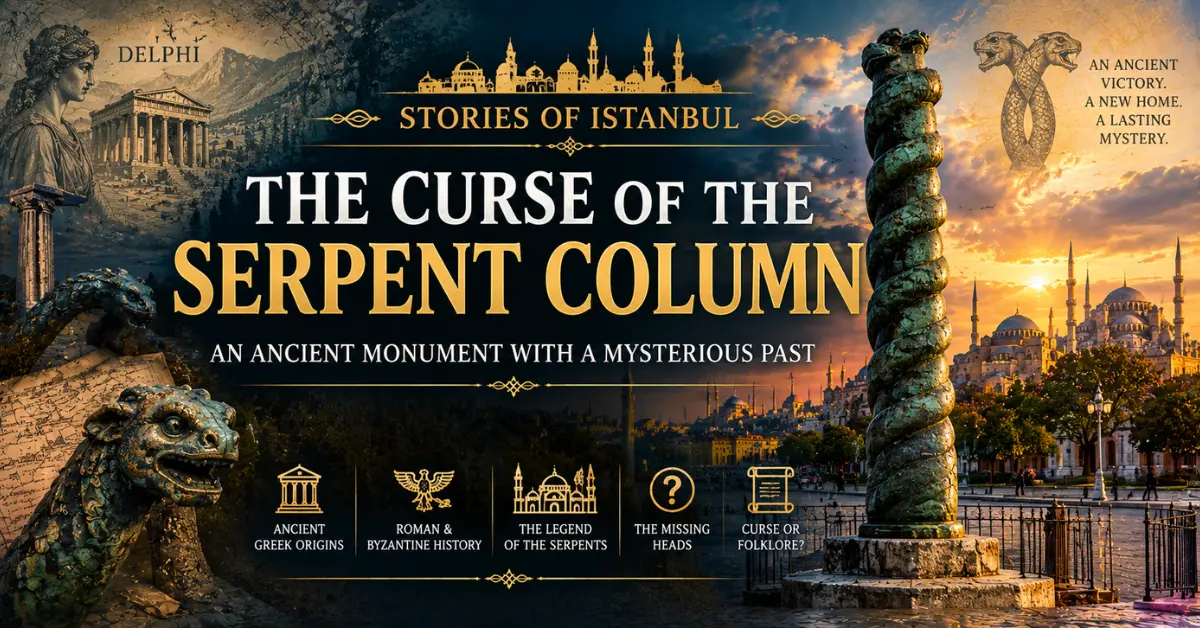
Yet the Serpent Column, known in Turkish as Yılanlı Sütun, is one of the oldest monuments still standing in Istanbul.
Its history reaches back more than two thousand years, long before the Ottoman Empire and even before Constantinople became the capital of the Byzantine Empire.
But the column is surrounded by a particularly intriguing mystery.
Where did it come from?
Why were three serpents placed on top of it?
What happened to their heads?
And is there really a curse connected to the Serpent Column?
The answers take us from ancient Greece to Constantinople and finally to modern Istanbul.
Welcome to another chapter of Stories of Istanbul.
What Is the Serpent Column?
The Serpent Column is an ancient bronze monument located in the historic Hippodrome area of Istanbul, today known as Sultanahmet Square.
It originally consisted of three intertwined serpent bodies forming a single column.
The monument was not originally created in Constantinople.
It was brought to the city during the reign of the Byzantine Emperor Constantine the Great in the 4th century.
By then, the monument was already centuries old.
Its original history is connected to the Greco-Persian Wars.
How Old Is the Serpent Column?
The Serpent Column dates to the 5th century BC.
It was created after the Greek victory over the Persian Empire at the Battle of Plataea in 479 BC.
This makes it one of the oldest surviving monuments in Istanbul.
Think about that for a moment.
When the monument arrived in Constantinople, it was already hundreds of years old.
Today, it has survived for more than two millennia.
The column therefore connects modern Istanbul directly with the ancient Greek world.
Why Was the Serpent Column Built?
The monument was created as a victory offering.
After the Greek city-states defeated the Persian forces, the Greeks dedicated valuable objects to the god Apollo at Delphi.
Among these was a bronze monument depicting three intertwined serpents.
The monument commemorated the Greek victory and honored the gods.
The names of the Greek city-states that participated in the victory were originally inscribed on the monument.
It was therefore not simply decorative.
It was a political, religious, and historical symbol.
Why Was the Serpent Column Brought to Istanbul?
The monument was transferred to Constantinople by Constantine the Great during the establishment and development of the new imperial capital.
Constantinople was intended to become a magnificent center of the Roman Empire.
Monuments from the ancient Greek and Roman world were brought to the new capital and displayed in prominent public locations.
The Serpent Column was placed in the Hippodrome.
This location was extremely important.
The Hippodrome was the center of public entertainment and political life in Constantinople.
Millions of people would eventually pass by the ancient monument.
What Did the Serpent Heads Look Like?
Originally, the three serpents had heads at the top of the column.
The three heads extended outward from the intertwined bodies.
Historical depictions and surviving evidence indicate that the monument once looked very different from what visitors see today.
The serpent heads disappeared sometime during the monument’s long history.
Their disappearance is one of the reasons the column became surrounded by legends.
What Happened to the Serpent Heads?
This is where historical evidence and popular stories begin to overlap.
The exact circumstances surrounding the destruction or removal of the serpent heads are not completely certain.
One serpent head is traditionally associated with a piece now displayed in the Istanbul Archaeological Museums.
However, stories about how the heads disappeared vary.
Some accounts connect their destruction with religious or political changes.
Others associate them with later damage.
There is no reliable evidence proving a supernatural event caused the disappearance.
Was the Serpent Column Really Cursed?
There is no historical or scientific evidence proving that the Serpent Column carries a supernatural curse.
The idea of a curse is largely part of the monument’s modern mystery and folklore.
However, the column’s history naturally lends itself to legends.
It survived ancient wars.
It was moved from Delphi to Constantinople.
It witnessed the rise and fall of empires.
Its serpent heads disappeared.
And it still stands in the center of Istanbul more than two thousand years after its creation.
That is enough mystery for several legends.
The Legend of the Serpent Heads
One popular tradition suggests that the serpent heads were destroyed because people believed the monument had a dangerous or pagan meaning.
Other stories connect the damage to individual rulers or historical events.
These versions should be treated as legends rather than established historical fact.
The actual history of the monument is much more complicated.
The column existed through several major religious and political transformations.
It began as a Greek victory monument dedicated to the gods.
It later stood in Christian Constantinople.
Then it survived into the Ottoman period.
Today, it is part of modern secular Istanbul’s archaeological landscape.
Did Mehmed II Destroy the Serpent Heads?
A popular story claims that Ottoman Sultan Mehmed II, after conquering Constantinople in 1453, struck or damaged the serpent heads.
This story is frequently repeated in connection with the monument.
However, it should not be presented as established fact without qualification.
Historical evidence concerning the exact circumstances of the serpent heads’ disappearance is more complicated than the popular legend suggests.
The story nevertheless became part of the monument’s mythology.
Why Did the Byzantines Keep a Pagan Monument?
This is one of the most interesting questions.
The Serpent Column had originally been associated with ancient Greek religion.
Yet it remained in Constantinople after the city became the capital of the Christian Roman Empire.
The answer is partly political.
Ancient monuments could be reused and reinterpreted.
For the emperors of Constantinople, displaying famous monuments from the ancient world could also demonstrate the city’s connection with classical civilization.
The column’s original religious meaning could therefore change while the monument itself remained.
The Serpent Column and the Hippodrome
The location of the Serpent Column is extremely important.
The ancient Hippodrome was one of the largest public spaces in Constantinople.
Chariot races attracted enormous crowds.
Political factions competed for influence.
Public ceremonies were held.
Imperial power was displayed.
Major monuments were placed around the Hippodrome to create a monumental public landscape.
The Serpent Column therefore stood in one of the most politically important areas of the Byzantine capital.
Why Are There Serpents?
The serpent has had many meanings throughout ancient cultures.
It could symbolize danger, protection, healing, renewal, or supernatural power depending on the cultural context.
In the case of the Serpent Column, the intertwined snakes were part of a victory monument associated with the ancient Greek world.
They should not automatically be interpreted using modern ideas about snakes or curses.
The symbolism belongs to a much older cultural context.
The Connection to Delphi
The original monument stood at Delphi, one of the most important religious centers of ancient Greece.
Delphi was famous for the Oracle of Apollo.
Greek cities travelled there to consult the oracle and make offerings.
The Serpent Column was therefore originally part of a sacred landscape.
Its movement from Delphi to Constantinople transformed its context completely.
A monument once connected with an ancient Greek sanctuary eventually became a landmark in the imperial capital of the Roman and Byzantine world.
What Does the Serpent Column Tell Us About Constantinople?
The column reveals something fundamental about Constantinople.
The city collected history.
Ancient monuments were transported into the capital.
Greek heritage became part of Roman imperial culture.
Roman traditions became part of Byzantine identity.
Later, Ottoman Istanbul inherited the monumental landscape.
This is why Istanbul can feel like several civilizations occupying the same space.
The Serpent Column is a perfect example.
Is the Serpent Column Still Standing Today?
Yes.
The lower portion of the original monument remains in Sultanahmet Square.
Although it has suffered damage and lost its serpent heads, the surviving bronze column is still visible.
Visitors can stand beside it and see one of the oldest surviving monuments in Istanbul.
It is easy to walk past without realizing just how ancient it is.
Where Is the Serpent Column?
The Serpent Column stands in Sultanahmet Square, close to several of Istanbul’s most famous historical landmarks.
It is located near:
- Hagia Sophia
- The Blue Mosque
- The Basilica Cistern
- The Hippodrome
- The German Fountain
- Topkapı Palace
This makes it easy to include in a historical walking route through Istanbul’s Old City.
Why Is the Serpent Column Important Today?
The monument is important because it represents a direct physical connection between modern Istanbul and the ancient Mediterranean world.
It has survived:
- Ancient Greek civilization
- The Roman Empire
- The Byzantine Empire
- The Ottoman Empire
- The foundation of modern Turkey
Very few monuments in Istanbul can tell such a long story.
The column is therefore more than an archaeological object.
It is a surviving witness to the transformation of the city.
Frequently Asked Questions
What is the Serpent Column in Istanbul?
The Serpent Column is an ancient bronze monument located in Sultanahmet Square. It was originally created in ancient Greece to commemorate the Greek victory over Persia at the Battle of Plataea.
How old is the Serpent Column?
The monument dates to the 5th century BC, making it more than 2,400 years old.
Why is it called the Serpent Column?
The monument originally consisted of three intertwined serpent bodies forming a bronze column.
Where did the Serpent Column come from?
It originally stood at Delphi in ancient Greece before being transferred to Constantinople during the reign of Constantine the Great.
What happened to the serpent heads?
The original serpent heads disappeared at some point in the monument’s long history. Different stories explain their destruction or removal, but the exact circumstances remain uncertain.
Is the Serpent Column cursed?
There is no reliable historical or scientific evidence that the monument is cursed. The curse is part of the folklore and mystery surrounding the monument.
Who destroyed the serpent heads?
Popular stories sometimes attribute the damage to Sultan Mehmed II, but the exact historical circumstances are more complicated and should not be treated as definitively established.
Can you see the Serpent Column today?
Yes. The surviving bronze column stands in Sultanahmet Square in Istanbul’s historic peninsula.
The Ancient Serpents Still Watching Istanbul
The Serpent Column has lost its heads.
Its original religious context has disappeared.
The empire that brought it to Constantinople is gone.
The Hippodrome around it has changed beyond recognition.
Yet the column remains.
For more than two thousand years, it has travelled from ancient Greece to Constantinople and then into modern Istanbul.
Its history contains wars, emperors, religions, political change, destruction, and legend.
Is it cursed?
There is no evidence to prove it.
But perhaps the real mystery is more impressive.
How did a monument created to celebrate an ancient Greek victory survive long enough to become part of Istanbul?
The answer is history itself.
And the Serpent Column is still standing there to tell the story.
This is Stories of Istanbul.