

Mysterious Symbols Inside Hagia Sophia
What Do the Ancient Marks, Crosses, Runes, and Inscriptions Really Mean?
Few buildings in the world have a history as complicated as Hagia Sophia.
Standing in the heart of Istanbul, Hagia Sophia has witnessed the rise and fall of empires, religious transformations, wars, earthquakes, restorations, and centuries of everyday life.
But look beyond its enormous dome, golden mosaics, marble columns, and famous calligraphy panels, and you will discover another fascinating layer of its history.
Symbols, inscriptions, carvings, and mysterious markings can be found throughout the building.
Some are religious.
Some identify individuals or groups.
Some were created by visitors centuries ago.
Others remain difficult to interpret.
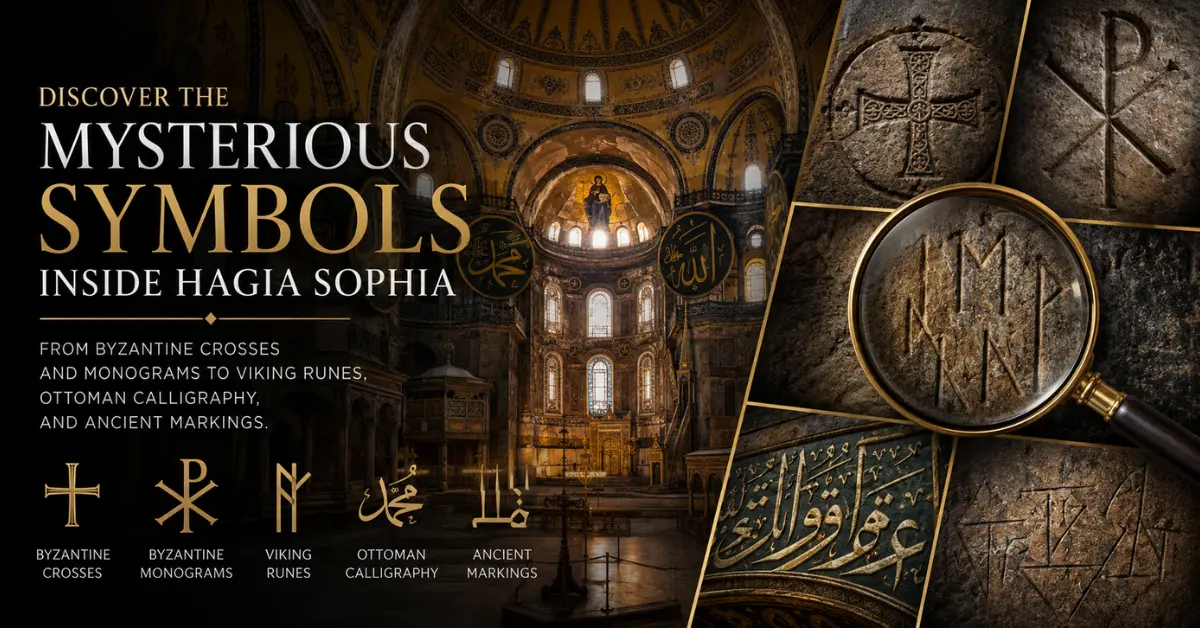
Among the most fascinating are Byzantine crosses, imperial monograms, marble inscriptions, Ottoman calligraphy, and the famous Viking-era runic graffiti associated with the Varangian Guard.
In this chapter of Stories of Istanbul, we explore the mysterious symbols inside Hagia Sophia and separate historical evidence from the legends that have grown around them.
Why Are There So Many Symbols Inside Hagia Sophia?
The simplest answer is its age.
Hagia Sophia was completed under Emperor Justinian I in the 6th century and has existed for nearly 1,500 years.
During that time, the building served different religious and political functions.
It was a major Byzantine Christian cathedral, later an Ottoman imperial mosque, then a museum, and it is currently a mosque again.
Each period left its own traces.
Byzantine Christians decorated the building with crosses, mosaics, inscriptions, and imperial imagery.
After the Ottoman conquest of Constantinople in 1453, Islamic architectural and artistic elements were added, including monumental calligraphic panels, a mihrab, minarets, and other modifications.
The result is a building where different historical layers remain visible side by side.
The Byzantine Crosses
One of the most recognizable types of symbols associated with Hagia Sophia is the Christian cross.
Crosses appear in different forms throughout Byzantine architecture and decoration.
Some are highly visible, while others are incorporated into architectural details and decorative elements.
Their presence reflects Hagia Sophia’s original function as one of the most important Christian churches in the Byzantine Empire.
However, not every cross inside Hagia Sophia necessarily has the same meaning.
Some may have been decorative.
Others could have carried religious or commemorative significance.
This is why historians and archaeologists examine the location, style, material, and historical context of individual markings before assigning a specific interpretation.
What Are the Mysterious Monograms?
Another fascinating feature of Byzantine architecture is the use of monograms.
A Byzantine monogram combines several letters into a single decorative symbol.
These could represent names, titles, religious phrases, or imperial associations.
At Hagia Sophia, inscriptions and decorative elements reflect the importance of the Byzantine emperors, the Christian faith, and the institution that controlled the building.
To a modern visitor, some of these designs may look like mysterious geometric symbols.
But they were often a sophisticated form of written communication.
Are There Viking Runes Inside Hagia Sophia?
Yes.
This is one of the most famous mysteries associated with the building.
Runic inscriptions were discovered on marble surfaces inside Hagia Sophia, and one of the best-known examples is associated with a Viking-era individual.
The markings are generally understood as runic graffiti, rather than official Byzantine decoration.
The presence of these inscriptions is particularly fascinating because Scandinavians served in the Byzantine Empire, especially as members of the elite Varangian Guard.
These warriors came from regions including Scandinavia and the wider Viking world and served the Byzantine emperors.
Their presence helps explain how Scandinavian runes could appear inside one of Constantinople’s greatest monuments.
What Do the Viking Runes Say?
This is where the mystery becomes even more interesting.
The runic markings are very brief and worn.
One famous inscription has been interpreted as containing a personal name or reference, but the exact meaning of every marking cannot be established with absolute certainty.
Rather than being a secret Viking message revealing a hidden conspiracy, the graffiti is better understood as evidence that people who spoke and wrote Scandinavian languages actually visited Hagia Sophia.
In other words, the markings provide a small glimpse into the human side of Byzantine history.
Someone stood inside this enormous imperial church many centuries ago and left a mark behind.
Who Were the Varangian Guard?
The Varangian Guard was an elite military unit that served the Byzantine emperors.
Many of its members came from Scandinavia and later from territories associated with the Kievan Rus’.
The guards were famous for their loyalty and military reputation.
Their connection to Hagia Sophia is particularly fascinating because it demonstrates how international Constantinople had become.
People from different parts of Europe and the wider Mediterranean world passed through the city.
A Scandinavian warrior could serve the Byzantine emperor, visit Hagia Sophia, and leave behind a tiny inscription that survived for centuries.
Are There Secret Messages Hidden in Hagia Sophia?
There is no reliable evidence of a vast secret code hidden throughout Hagia Sophia.
However, the building contains many inscriptions and symbols whose original meanings are not immediately obvious to modern visitors.
Some inscriptions were created for religious purposes.
Others recorded names, events, donations, or architectural information.
Some markings were added by ordinary people.
The mystery comes partly from the fact that the building contains so many historical layers.
A symbol created in the Byzantine period can exist only a few meters away from an Ottoman inscription added centuries later.
What Do the Ottoman Calligraphy Panels Mean?
After the Ottoman conquest of Constantinople, Hagia Sophia was transformed into an imperial mosque.
One of the most visually striking additions was the monumental Islamic calligraphy.
The enormous circular panels display the names of important figures in Islamic tradition, including:
- Allah
- Muhammad
- Abu Bakr
- Umar
- Uthman
- Ali
- Hasan
- Husayn
These panels are among the most recognizable features inside Hagia Sophia today.
They demonstrate how the building was adapted to its new religious function while preserving much of its earlier architectural structure.
Why Are Christian and Islamic Symbols Together?
This is one of the reasons Hagia Sophia is so historically significant.
The building was not simply destroyed and replaced every time its function changed.
Instead, different periods modified and adapted it.
Byzantine Christian mosaics survived alongside later Ottoman Islamic elements.
Architectural features from different centuries therefore exist within the same monumental space.
This makes Hagia Sophia a visual record of Istanbul’s changing history.
The Mosaics: More Than Decoration
Hagia Sophia’s famous mosaics contain another layer of symbolism.
Figures of Christ, the Virgin Mary, emperors, and other religious figures appear in different parts of the building.
Many mosaics date from different periods because the building experienced destruction, earthquakes, restoration, and political change.
Some were covered or altered during the Ottoman period and later revealed or conserved during modern restoration campaigns.
The mosaics therefore provide important evidence about Byzantine art, theology, imperial power, and the history of the building itself.
The Seraphim Faces
Another intriguing feature is the monumental seraphim imagery associated with the pendentives beneath the dome.
Seraphim are celestial beings described in the biblical tradition.
The famous faces associated with Hagia Sophia have attracted considerable attention because of their scale and location.
For centuries, some of these images were covered or partially concealed.
Their restoration and visibility today provide another example of how different layers of Hagia Sophia’s history have been revealed over time.
Are There Secret Symbols in the Hagia Sophia Columns?
The enormous marble columns inside Hagia Sophia have generated countless stories.
Some columns were brought from other ancient buildings and reused in the construction of the church.
Their different colors, materials, origins, and decorative details reflect the Byzantine practice of reusing valuable architectural elements.
This process is known as spolia.
Rather than being random decoration, reused columns could demonstrate imperial power and connect the new building with the architectural heritage of the ancient world.
Why Does Hagia Sophia Feel Like a Collection of Different Civilizations?
Because it is.
Few monuments contain such a concentrated record of different historical periods.
Inside a single building, visitors can encounter:
Roman heritage → Byzantine Christianity → Ottoman Islam → Modern Turkish history
The architecture itself tells the story.
The dome represents Byzantine engineering.
The mosaics reveal Christian artistic traditions.
The minarets reflect Ottoman architectural transformation.
The calligraphy represents Islamic artistic heritage.
The inscriptions and graffiti reveal the people who passed through the building.
The Most Mysterious Mark May Be the Smallest One
Visitors naturally focus on the enormous dome and magnificent mosaics.
But some of the most fascinating historical evidence is surprisingly small.
A tiny inscription.
A worn carving.
A monogram.
A piece of graffiti.
A symbol whose original meaning has been forgotten.
These small details remind us that Hagia Sophia was not simply a monument.
It was a living building.
Millions of people passed through its doors over many centuries.
Some were emperors.
Some were soldiers.
Some were religious figures.
Some were merchants.
Some were ordinary visitors.
And some left their names behind.
Frequently Asked Questions
What are the mysterious symbols inside Hagia Sophia?
They include Byzantine crosses, monograms, religious imagery, inscriptions, graffiti, Ottoman calligraphy, and other architectural markings created during different periods of the building’s history.
Are there Viking runes inside Hagia Sophia?
Yes. Runic graffiti has been documented inside Hagia Sophia and is associated with the presence of Scandinavian and Varangian individuals in Constantinople.
What do the Viking runes in Hagia Sophia mean?
The surviving runic markings are brief and worn, so interpretations are limited. They are generally regarded as personal graffiti rather than a hidden secret message.
Why are there Christian symbols inside Hagia Sophia?
Hagia Sophia was originally built as a Christian cathedral and served as one of the most important churches of the Byzantine Empire for centuries.
Why are there Islamic symbols inside Hagia Sophia?
After the Ottoman conquest of Constantinople in 1453, Hagia Sophia was converted into an imperial mosque and received Islamic architectural and artistic elements.
Does Hagia Sophia contain secret messages?
There is no reliable evidence of a large hidden code or secret message system. However, the building contains many historical inscriptions and symbols whose meanings require specialist study.
How old are the symbols inside Hagia Sophia?
They come from different periods. Some are associated with the Byzantine era, while others were added during the Ottoman period and later.
The Real Mystery of Hagia Sophia
The greatest mystery inside Hagia Sophia may not be a hidden code or forgotten secret.
It is the building itself.
For almost 1,500 years, Hagia Sophia has survived earthquakes, political upheaval, religious transformation, fires, restorations, and enormous changes in Istanbul.
Its walls preserve traces of people who lived in completely different worlds.
A Byzantine emperor could have looked at the same dome that an Ottoman sultan later saw.
A Scandinavian warrior could have walked across the same marble floor where modern travelers stand today.
An ancient cross can exist within the same building as Ottoman calligraphy.
That is what makes Hagia Sophia extraordinary.
Its symbols are not just mysterious markings. They are fragments of Istanbul’s story.
And when you know how to read them, Hagia Sophia becomes more than a historic monument.
It becomes a 1,500-year-old book written in stone, marble, mosaic, ink, and memory.
This is Stories of Istanbul.